
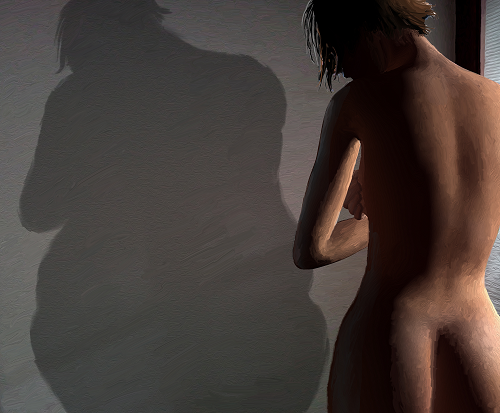
image by Adam Selwood
Fingers splayed wide and palm protectively pressed to her belly, she stood, shocked into silence, staring at the stranger before her, a stranger who, until moments before, had been her husband. Her eyes were wide and surely her jaw was dropped—that’s what people said happened in moments of utter disbelief—as the cyclone whirled inside her head, bouncing thoughts around haphazardly, collecting unrelated debris and shattering existing intellectual structures in its path of mental deconstruction.
Surely she must have felt this storm rising; nothing comes from nothing, there must have been warning signs that she ignored. But while the tempest swirled across her mental landscape, outwardly she made no movement, no sound, perhaps not even a blink of her eye as she stood riveted to the spot where she stood, looking at the man she thought she knew.
Regaining awareness of her physical body, she groped blindly behind her, right hand still protectively shielding her belly, and found a dining room chair with her outstretched left fingertips. She sank gratefully into its stability and closed her eyes momentarily, taking a few deep breaths. He too seemed compelled to sit, as if, perhaps, shocked and, to a certain extent, relieved by his own proclamation.
The argument between them had bounced back and forth over the course of multiple hours; it was approaching midnight and the first iron had been struck shortly before she had tucked her three year old daughter in bed. Neither party was innocent in this battle, both had grievances to air, complaints that had been festering for quite some time—years, she had just been informed.
Exhausted, she needed the battle to halt, not forever—she knew that was an impossibility—but long enough for her mind to readjust to the latest thrust.
She did not reopen her eyes until she could feel some of the color coming back into her cheeks, until she could again sense the steady heartbeat that thumped beneath her breast, until she felt that words—not screams—would come from her mouth. When she did finally peel back the curtain shielding her from the reality sitting before her, she took in the scene in an objective way.
The house was dim, only one reading lamp illuminated the family room behind her and countertop light shone from the kitchen to her left, the rest was engulfed in a quiet but now peaceful gloom. The yelling was over. There would be no need for more.
She looked down at her hands, resting one inside the other in her lap, curled under where soon her belly would expand to make room for the new life growing within. She imagined those hands holding her baby, caressing a cheek, running them through soft hair, holding a tiny hand in her own—and she bit back on her tears. She was done crying. She was done fighting. She was done trying to change his mind. The choice was now with her and she knew there was no real choice to be made.
She looked up at his face, weary, worn, exhausted—unhappy. How long had he looked this way and she had just not noticed? How long had he been silently telling her he needed to leave? How long had his resentment seethed beneath the surface before it bubbled forth and erupted on her consciousness as it had this night?
“I’m sorry,” she whispered, certain of the truth behind her words, but not entirely sure what that sorrow actually expressed.
He looked at her through red-rimmed eyes—although no tears had fallen it was clear that the emotional turmoil of the night had taken its toll on him as well. “I can’t do this again. I just can’t.” His eyes pleaded with her to understand the feelings he could not find the words to express: exhaustion, desperation, imprisonment, resentment, animosity, indifference, detachment. Her anger of moments earlier dissipated looking into his eyes and was replaced with sorrow tinged with compassion.
He’d offered her a choice, but the choice he had voiced was not truly what he wanted; it was what he felt was the only option he could decently express.
It sounded simple enough, but when she looked in his eyes and saw no trace of love, when she thought back to the things he had said—yes, people say what they regret during the course of an argument, but the rarely say what they don’t mean—when they fought earlier that evening, the choice he voiced was not truly the one he was offering.
His mouth said, “It’s me or the baby. You choose.” But his eyes could not lie, “I don’t want either of you. Let me go,” they pleaded. She could not ignore the testimony of those eyes.
“You offer me no real choice here. It’s not the baby you don’t want. It’s this…” right hand sweeping across the landscape of the house, encompassing the life they had created over the past 10 years. “I understand that. I know you think I don’t, but I do. You offer me no real choice when you tell me that you haven’t loved me for years or that you resent me for being pregnant with our child.” She returned her palm possessively to the baby growing within her. “Even if I were willing to consider your choice, what guarantee do I have that you wouldn’t decide this life isn’t what you want anyway? Then I would have sacrificed this life I have wanted for so long on the alter of your confusion. You want your freedom? You can have it. I’m keeping my child.”
His voice cracked slightly as he spoke, “I never meant to hurt you.”
“I’m sure you didn’t—but you have. I’d like to say that I won’t harbor anger towards you for this, but I will. I’d like to say that I forgive you for this, but I can’t—not yet. Someday I will, but not for a long time.” She looked back down to her hands, wiping the moisture from her palms onto her skirt, engrossed in the action.
Silently he pushed back the chair from the table and stood. “I’m the world’s worst father. You don’t need me anyway.” With that her turned from the room, grabbed his jacket and walked out the front door, closing it gently behind him.



 hocscripsit